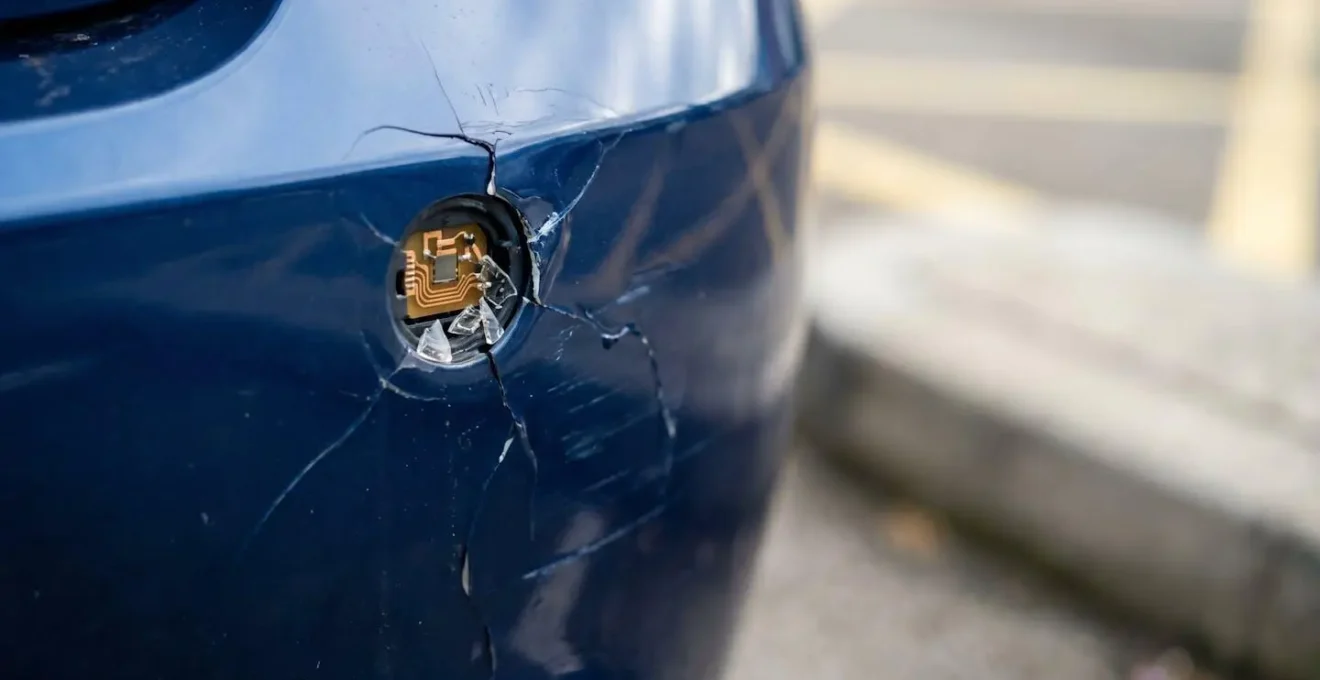
That sickening crunch from a minor bump can trigger major financial pain far beyond the initial repair bill, especially on a third-party only policy.
- Your insurer’s “market value” payout for a written-off car often won’t cover your outstanding finance agreement, leaving you in debt for a car you no longer own.
- Even if repairable, you have the legal right to choose a manufacturer-approved bodyshop, protecting your car’s warranty and value against insurer pressure to use their network.
Recommendation: Understand the real-world financial chain reaction of accidental damage now, so you can verify your insurance coverage is fit for purpose before you ever need it.
It’s a sound every driver dreads: the low, grinding crunch of metal against concrete. You’ve just reversed into a bollard. After the initial frustration, your thoughts turn to insurance. A quick check of your policy documents confirms your fear: “Third Party Only”. Your heart sinks. You know this covers damage to the bollard, but what about the crumpled bumper and cracked tail light on your own car? The common advice, “you should have bought comprehensive cover,” is cold comfort now.
As a bodyshop manager, I see the aftermath of these moments every day. The reality of “self-inflicted” damage goes far beyond a simple repair bill. It’s the start of a potential financial cascade—a series of hidden traps that can turn a minor mishap into a major financial headache. The conversation isn’t just about the dent; it’s about economic write-offs on nearly new cars, significant shortfalls on finance agreements, and disputes over who is qualified to perform the repair.
The difference between what your policy document says and the reality on the workshop floor can be thousands of pounds. This isn’t just about insurance theory; it’s about the practical, step-by-step consequences that unfold from the moment a damaged vehicle arrives at our door. We’ll break down this chain reaction, giving you the practical knowledge to understand the risks and navigate your options if the worst happens.
This article unpacks the critical questions that arise after an at-fault accident. The following summary outlines the key financial and logistical hurdles you might face, from understanding write-off classifications to asserting your rights as a vehicle owner.
Summary: The Financial Consequences of a Bollard Collision
- Cat S vs Cat N: Understanding Salvage Categories After a Crash?
- Return to Invoice: Why Market Value Payouts Don’t Cover Your Finance?
- Approved Repairer vs Your Choice: Can You Pick Who Fixes Your Car?
- Petrol in Diesel: Is Draining the Tank Covered by Insurance?
- Lost Keys: Does Your Policy Pay for Coding a New Fob?
- Broken Glasses: Does Home Insurance Cover Accidental Damage?
- BVRLA Standards: What Counts as Fair Wear and Tear on Return?
- PCH Insurance: Do You Need GAP Insurance for a Lease Car?
Cat S vs Cat N: Understanding Salvage Categories After a Crash?
When your car arrives at the workshop after hitting that bollard, the first question isn’t “can we fix it?” but “is it economical to fix it?”. Insurers use a simple calculation: if the cost of repair exceeds a certain percentage of the car’s pre-accident value, it’s declared an “economic write-off”. This is the repair threshold, and it’s the first major hurdle. In the UK, a staggering 562,185 vehicles were written off in 2024, showing how common this outcome is. You don’t need a catastrophic crash to get there.
With modern vehicles, this threshold is met surprisingly quickly due to what we call non-structural cost escalation. That small bump might have damaged more than just the plastic bumper. It could have knocked out parking sensors, a reversing camera, or radar units for cruise control. These components are incredibly expensive to replace and, crucially, require specialist recalibration. A repair bill that is between 50-70% of a vehicle’s value is often enough to write it off.
If the car is written off, it’s assigned a salvage category. Cat S (Structural) means it has sustained damage to its chassis or structural frame and must be professionally repaired and re-registered. Cat N (Non-structural) means the damage is cosmetic or to parts like the engine or electrical systems, but not the core structure. While a Cat N car can be put back on the road, its value is significantly diminished, and it carries a stigma that makes it harder to sell or insure in the future. For a driver with third-party only cover, this is the worst-case scenario: you receive no payout and are left with a damaged, devalued asset, or a bill for its disposal.
Return to Invoice: Why Market Value Payouts Don’t Cover Your Finance?
Let’s assume you have comprehensive cover and your car is written off. The insurer agrees to pay out its “market value”—what a similar car is worth today. This is where the second financial trap springs: the financial shortfall. The market value and the amount you still owe on your finance agreement are two very different numbers. Cars depreciate rapidly; new car depreciation statistics show a potential 60% value loss in the first three years, with most of that happening in year one.
Your finance settlement, however, depreciates much more slowly. This creates a dangerous gap between what the insurer pays you and what you must pay the finance company. If this gap exists, you are personally liable for the difference. You end up with no car, but still have a monthly debt for an asset you no longer possess. This is where Guaranteed Asset Protection (GAP) insurance becomes critical.
Case Study: The £4,000 Finance Shortfall
Imagine your car, written off after an accident, has a market value of £15,000, which your insurer agrees to pay. However, you still have £19,000 outstanding on the finance agreement you took out when you bought it. The insurer pays the £15,000 directly to the finance company, but this still leaves a £4,000 deficit. Without GAP insurance to cover this specific gap, the finance company will pursue you for that remaining £4,000. This is a common and shocking reality for many drivers.
There are different types of GAP insurance, but the most common is “Return to Invoice” (RTI), which tops up the insurer’s market value payout to the original price you paid for the car. Another is “Finance GAP”, which simply clears the outstanding finance. For a driver who hit the bollard on a third-party policy, this is all academic—there is no initial payout to ‘top up’. But for anyone with a financed car, it highlights the severe limitations of relying solely on standard comprehensive cover.
Approved Repairer vs Your Choice: Can You Pick Who Fixes Your Car?
If your car is deemed repairable, the next battle begins: who gets to fix it? Your insurer will immediately try to direct you to their “approved repairer network.” They present this as the easiest, simplest option. However, their priority is cost, not quality. An insurer’s approved shop may not have the specific tools, training, or manufacturer-approved parts to repair your vehicle to factory standards. Using non-genuine parts or incorrect procedures can invalidate your vehicle’s warranty and significantly reduce its resale value.
This is where you need to understand your rights. Many drivers are unaware that they are not obligated to use their insurer’s choice of garage. In the bodyshop world, we call this asserting your right to the chain of custody for your vehicle’s repair. A specialist bodyshop with official manufacturer approval is best placed to protect your asset. As one industry guide puts it:
Under UK law, you have the right to choose your own repairer. Your insurer cannot force you to use their approved network, and they cannot refuse to pay a valid claim simply because you chose an independent bodyshop.
– Linwood Coachworks, Consumer rights guide on repairer choice
Insurers may try to deter you by warning of delays or stating you may have to pay a higher excess. Standing your ground is vital to ensure a quality repair that protects your car’s safety systems and future value. You are the customer, and the final decision is yours.
Your Action Plan: Asserting Your Right to Choose a Repairer
- State your choice clearly: Inform your insurer, “I wish to exercise my legal right to choose my own repairer. I am directing my vehicle to [your chosen facility].” Be firm and direct.
- Address the warranty argument: If they push back, state, “My chosen repairer holds factory approvals for my vehicle’s manufacturer. Using your network garage will risk voiding my vehicle warranty, which I am not prepared to do.”
- Ask for written confirmation if they resist: Say, “If you are refusing my request or penalizing me for choosing a certified factory-approved repairer, please send me that policy restriction in writing so I can forward it to the Financial Ombudsman.”
- Verify ADAS calibration capability: Ask your chosen bodyshop the right questions, such as “Do you have manufacturer-approved diagnostic tools for my model?” and “Is your ADAS recalibration work certified and warrantied?” to justify your choice.
Petrol in Diesel: Is Draining the Tank Covered by Insurance?
Hitting a bollard is a physical error; misfuelling is a mental one. Putting petrol in a diesel car (or vice-versa) is another common, self-inflicted mishap. The moment of realisation is often followed by the same question: “Am I covered?”. The answer, as with most things in insurance, is “it depends”. Many comprehensive policies with an accidental damage component will cover misfuelling. However, making a claim is not always the smartest financial move.
The cost of a specialist mobile service to drain, flush, and replenish your fuel system is typically a few hundred pounds. This is often less than, or very close to, your policy’s compulsory excess. Claiming would mean you pay the excess anyway, and you also gain a fault claim on your record. This will almost certainly lead to a significant premium increase at renewal, costing you far more in the long run than the initial call-out fee. It’s a classic case of a short-term fix causing long-term financial pain.
The worst thing you can do is start the engine. This circulates the wrong fuel, causing potentially catastrophic damage to the engine and fuel system, with repair bills running into thousands. This level of damage would almost certainly not be covered, as it’s seen as a consequence of a reckless action. The following table breaks down the financial reality.
| Option | Immediate Cost | Long-term Impact | Outcome |
|---|---|---|---|
| Claim on insurance | Policy excess (typically £250-£500) | Premium increase at renewal (potential 20-30% rise) | Covered if policy includes accidental damage; may affect no-claims bonus |
| Specialist misfuelling service | One-off fee (£150-£300) | No impact on premiums or claims history | Immediate roadside resolution without insurance involvement |
| No action (drive with contaminated fuel) | None initially | Engine damage repair (£1,000-£5,000+) | Not covered by insurance; catastrophic mechanical failure likely |
Lost Keys: Does Your Policy Pay for Coding a New Fob?
In the world of accidental damage, losing your car keys is another frustrating and surprisingly expensive event. Gone are the days of getting a spare cut at a local hardware store for a few pounds. Modern car keys are sophisticated electronic devices—transponder fobs that communicate with the vehicle’s immobiliser. Replacing one isn’t just about cutting a new metal blade; it’s about coding a new fob to the car’s ECU (Engine Control Unit).
This process often requires specialist, dealer-level diagnostic equipment. The cost for a single replacement key fob, including the programming, can easily run from £200 to over £500, depending on the make and model. If you’ve lost all keys, the cost can be even higher as it may involve replacing the locks and the immobiliser unit itself. From a bodyshop perspective, we see this when cars come in for repair after a theft, and the locks need changing as a security measure.
So, does insurance cover it? Many comprehensive policies include a limited amount of cover for lost or stolen keys as standard, often up to a certain value (e.g., £500). Some insurers offer a specific “Key Cover” as an optional add-on for a small extra premium. This add-on is often a good value proposition, as it usually has a very low or zero excess and making a claim on it typically does not affect your main no-claims bonus. For a third-party only policyholder, however, you’re on your own. The entire cost of replacement and coding falls on you, another example of a seemingly small incident leading to a significant, unexpected bill.
Broken Glasses: Does Home Insurance Cover Accidental Damage?
This question is a perfect example of the confusion between different types of insurance. Typically, accidentally breaking your personal spectacles would be a matter for your home insurance, specifically under a “Personal Possessions” add-on. It highlights the importance of ensuring cover for items used both inside and outside the home. However, the underlying principle—the concept of an excess—is directly relevant to car insurance and that bump with the bollard.
Let’s pivot back to your car. Imagine the repair estimate for the damage from the bollard is £600. Your comprehensive car insurance policy has a compulsory excess of £250 and a voluntary excess of £250, making a total excess of £500. This means you must pay the first £500 of any claim. In this scenario, if you claim, the insurer would only contribute £100 towards the repair. The phrase from Insurance.com states “Collision coverage helps pay for repairs to your vehicle if it’s damaged in a collision with another car or object”, which is true, but it’s not the whole story.
Making that claim for a net benefit of just £100 would be a poor financial decision. You would have a fault claim on your record for the next five years, leading to substantially higher premiums at every renewal, costing you many times more than the £100 you saved. This is the excess trap. In the workshop, we frequently advise customers that if the repair cost is only slightly more than their total excess, it is almost always cheaper in the long run to pay for the repair themselves and protect their no-claims history. For the third-party driver, of course, there is no choice: you pay the full amount yourself.
BVRLA Standards: What Counts as Fair Wear and Tear on Return?
If the car you reversed into a bollard was a lease vehicle, you face another layer of financial scrutiny: the end-of-contract inspection. Lease companies, often guided by the British Vehicle Rental and Leasing Association (BVRLA) “Fair Wear and Tear” standards, will meticulously inspect the vehicle before you hand it back. The core purpose of these standards is to differentiate between acceptable, minor deterioration from normal use and specific damage that requires repair.
From a bodyshop’s point of view, “fair wear and tear” includes things like small stone chips on the bonnet, light surface scratches that can be polished out, and minor scuffs on the alloy wheels. These are considered an unavoidable part of driving. The standards are quite specific, often using a credit card or the inspector’s thumb as a size guide for acceptable marks.
However, the damage from hitting a bollard falls squarely and unambiguously into the category of unacceptable damage. A dented bumper, cracked light lens, or a deep scratch that has broken the paint surface is never considered fair wear and tear. When the lease inspector finds this damage, you will be presented with a bill for the repair. Crucially, this bill will be based on their own approved bodyshop’s retail rates, which are often significantly higher than what you might pay if you arranged the repair yourself at an independent garage beforehand. Ignoring damage and hoping for the best on a lease return is a guaranteed way to receive an inflated and non-negotiable repair invoice.
Key Takeaways
- A minor, at-fault accident can easily trigger an economic write-off on a modern car due to the high cost of replacing and calibrating sensors and safety systems.
- Your insurer’s “market value” payout will likely not cover your outstanding car finance, creating a “financial shortfall” that you are personally liable for.
- You have the legal right to choose your own manufacturer-approved repairer; using an insurer’s network may not be the best option for your car’s warranty or future value.
PCH Insurance: Do You Need GAP Insurance for a Lease Car?
For drivers on a Personal Contract Hire (PCH) or lease agreement, the financial consequences of a write-off are particularly severe. If the leased car you hit the bollard with is declared a total loss, your standard motor insurance (if comprehensive) pays out the current market value. This payout goes directly to the lease company, who are the legal owners of the vehicle.
However, the lease company’s settlement figure—the amount they require to end the agreement—is almost always higher than the car’s market value. This figure includes the lost value of the car plus any remaining rental payments. You are contractually obligated to pay the difference, which can amount to thousands of pounds. This makes GAP insurance not just a good idea, but an absolute necessity for anyone leasing a car. It is the only thing that stands between you and a massive, unexpected bill for a car that no longer exists. The global GAP insurance market was valued at USD 3.9 billion in 2023, demonstrating how vital this product has become in a world of financed and leased vehicles.
It’s worth noting that the product has come under scrutiny for not always providing fair value. As stated by the Financial Conduct Authority (FCA), there are concerns in the market. In a recent review, Sheldon Mills, FCA Executive Director, noted, “GAP insurance can provide a useful service to customers, but in its current form it does not offer fair value and we want to see improvements.” This highlights the importance of shopping around and understanding exactly what a policy covers rather than simply accepting the one offered by the car dealership.
For leased vehicles, the most common and necessary type is Finance/Contract-Lease Hire GAP Insurance. This policy is specifically designed to pay the difference between your motor insurer’s settlement and the amount outstanding on your lease agreement, ensuring you can walk away without any further financial liability to the lease company.
Ultimately, reversing into a bollard is more than just an inconvenience; it’s a stark lesson in the realities of modern car ownership and insurance. From the workshop floor, the message is clear: understanding the gaps in your cover and the real-world value of your asset is not a task for later—it’s essential preparation. The next step is to take this practical knowledge and proactively review your own policy. Don’t wait for the crunch of metal to find out if you’re properly protected.