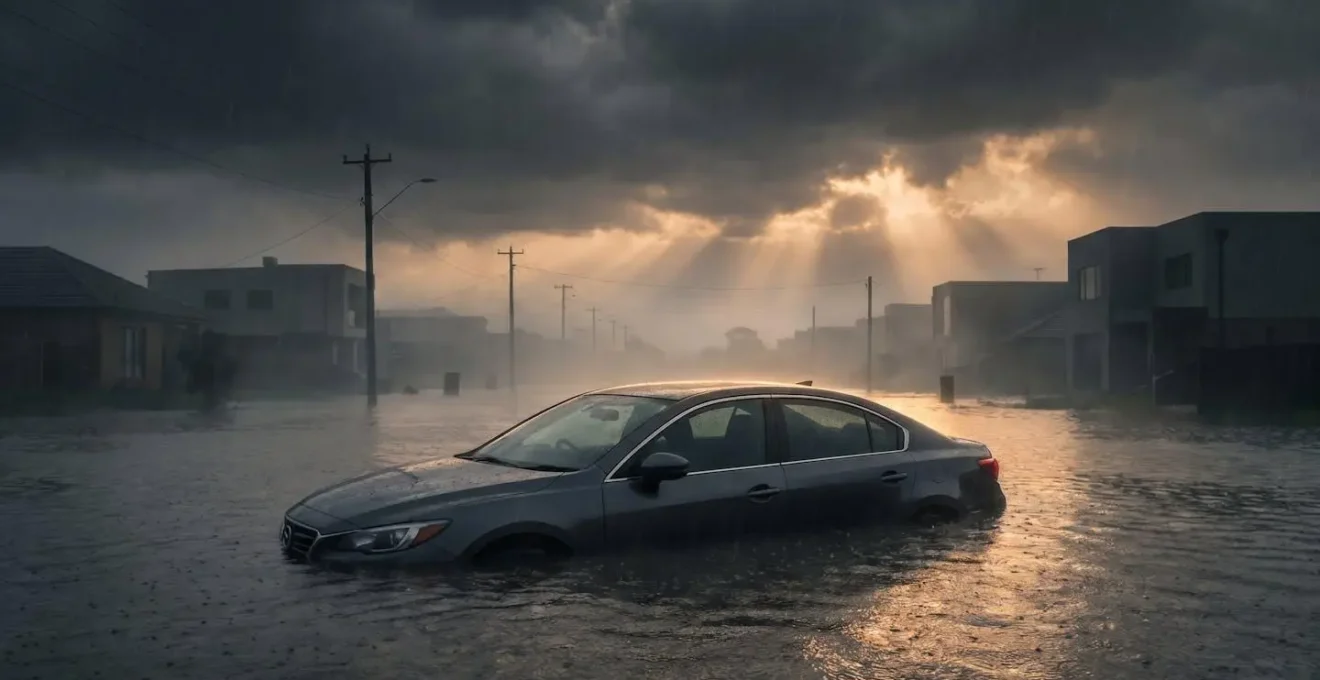
Your comprehensive policy is not a guarantee of payment; it’s a contract that hinges on whether damage was foreseeable and preventable.
- An “Act of God,” like a tree falling in a storm, is typically covered because it’s unpredictable and unavoidable.
- Intentionally driving into a flooded road can be classified as a negligent act, potentially leading to a denied claim for engine damage.
Recommendation: Treat standing water on the road as a significant hazard. The decision to drive through it, not the water itself, is what a loss adjuster will scrutinize.
You see the water pooling ahead. It doesn’t look too deep. Other cars have made it through, and you’re already running late. The temptation is to push on, trusting that your comprehensive car insurance will handle any unfortunate outcomes. After all, isn’t that what “fully comp” is for? This is a common assumption, and a costly one. As a loss adjuster, my role is to investigate the “why” behind the damage, and the line between an unavoidable accident and a preventable mistake is where a claim is won or lost.
Many drivers believe their policy is a safety net for any eventuality, from freak weather to minor collisions. However, the core principle of insurance rests on the concept of fortuitous, unforeseen events. The moment a driver makes a conscious decision to enter a hazardous situation, the narrative changes. The question is no longer “what happened?” but “what role did your judgement play in the outcome?”. This distinction is the difference between a paid repair and a letter of denial.
This article will dissect several common but ambiguous claim scenarios from an adjuster’s perspective. By examining the evidence and liability in each case, from falling trees to road debris, we will uncover the consistent logic that insurers apply. The goal is to move beyond the policy brochure and understand the forensic mindset that ultimately determines if your claim for something like hydrostatic lock from a “puddle” is approved.
In this investigation, we will break down the specific criteria used to evaluate a range of common yet often misunderstood insurance claims. By exploring these real-world examples, you will gain a clearer understanding of your responsibilities as a policyholder and the critical factors that influence an insurer’s final decision.
In this Investigation: A Breakdown of Common Claims
- Falling Trees: Acts of God and Insurance Payouts?
- Hitting a Deer: Is It an At-Fault Claim or Bad Luck?
- PDR Repair: Fixing Dent Damage from Summer Storms?
- Council vs Insurer: Who Pays for Your Busted Suspension?
- Paint Spills on the Road: Can You Claim for Respraying Your Car?
- Damp and Mould: When Does Condensation Become a Landlord’s Legal Liability?
- Act of God or Negligence: Are You Liable if Your Tree Crushes a Car?
- Fully Comp: Does It Really Cover Everything, Even Your Own Stupidity?
Falling Trees: Acts of God and Insurance Payouts?
When a violent storm brings a tree down onto your parked car, the situation seems clear-cut. This is often labelled an “Act of God”—a legal and insurance term for an event caused by natural forces without human intervention. For the vast majority of drivers, this is precisely why they have comprehensive coverage. Indeed, data from the Insurance Information Institute indicates that about three-quarters of people carry comprehensive coverage, which is designed for such non-collision events.
From an adjuster’s standpoint, a claim for a healthy tree falling during a documented severe weather event is typically straightforward. The proximate cause is the storm, an external and uncontrollable peril. The evidence—weather reports, photos of the scene, the condition of the tree itself—all point to an unavoidable accident. Your comprehensive policy is designed to respond in this exact scenario, covering the costs of repair or, if necessary, the total loss of the vehicle, subject to your excess.
However, the “Act of God” defence is not absolute. The investigation changes if the evidence suggests a degree of negligence. What if the tree was visibly dead, rotten, and leaning precariously for months? In this case, the owner of the tree (whether it’s you or your neighbour) may have failed in their duty of care. The storm was merely the final push. While your own comprehensive policy might still pay out initially, your insurer would likely then pursue the tree owner’s liability insurance to recover their costs, a process known as subrogation. The key takeaway is that even in an “Act of God” event, the underlying context of foreseeability and negligence is always a part of the investigation.
Hitting a Deer: Is It an At-Fault Claim or Bad Luck?
A deer darting into the road at dusk presents one of the most unambiguous scenarios in auto insurance. Unlike a collision with another vehicle, hitting an animal is almost universally considered a non-fault incident covered under the comprehensive portion of your policy. The logic is simple: the animal’s actions are unpredictable and beyond a driver’s control. An adjuster investigating such a claim is not looking to assign blame to the driver but to verify the circumstances of the loss.
The forensic evidence at the scene and on the vehicle tells a clear story. The presence of animal fur, the specific pattern of impact damage, and the location of the incident all corroborate the driver’s report. This type of claim is a significant factor in the industry; in the US alone, State Farm estimates 1.7 million auto insurance claims from animal collisions occur annually, highlighting the frequency of these unavoidable encounters. This is not considered an “at-fault” accident, meaning it typically will not affect your no-claims bonus or lead to a premium increase in the same way a collision with another car would.
The distinction is critical. If you swerve to avoid the deer and hit a tree instead, the claim’s nature can change. The proximate cause of the damage is now the impact with the tree, which falls under the collision part of your policy. Depending on the insurer and the specifics of your policy, this could be viewed as an at-fault accident. The adjuster’s advice is consistent: it is often safer, for both your physical well-being and your insurance claim, to brake firmly in a straight line rather than taking evasive action that could lead to a more complex and potentially liable collision.
PDR Repair: Fixing Dent Damage from Summer Storms?
Summer thunderstorms can bring more than just heavy rain; they often unleash hailstones that can leave a car looking like a golf ball. This type of damage is another classic example of a peril covered by comprehensive insurance. Much like a tree falling in a storm or a collision with a deer, hail damage is an unpredictable and unpreventable natural event. Policyholders with comprehensive cover can typically claim for these repairs without it being considered an at-fault incident.
The standard repair method for this is Paintless Dent Repair (PDR), a specialised technique where technicians massage the dents out from the underside of the body panel, preserving the original factory paint. For an adjuster, approving PDR is often a preferred outcome as it’s typically faster and more cost-effective than traditional bodywork and repainting. The evidence is straightforward: a Met Office report confirming a hailstorm in your area at the time of the damage is usually sufficient to validate the claim.
The increasing frequency and intensity of such weather events across Europe are making these claims more common. For instance, the German Insurance Association reported that severe natural hazards in 2024 resulted in a high number of insurance claims across Germany, with flooding and storms acting as primary drivers. This trend underscores the value of comprehensive coverage as a buffer against the financial impact of climate-related vehicle damage. The key for a smooth claim is clear documentation: photos of the damage, the location of the vehicle, and noting the date and time of the storm.
Council vs Insurer: Who Pays for Your Busted Suspension?
You’re driving along a familiar road, and suddenly, a bone-jarring crash echoes through the car. You’ve hit a pothole. A quick inspection reveals a buckled wheel, a damaged tyre, and a potential issue with your suspension. The immediate question is: who is responsible for the bill? This scenario moves the investigation away from “Acts of God” and into the complex world of public liability and duty of care.
Your first port of call may be your own comprehensive or collision policy, which can cover the damage. However, this will likely count as a claim on your record and require you to pay your excess. The alternative, and often more arduous path, is to pursue a claim against the authority responsible for maintaining the road—typically the local council or highways agency. This is not an insurance claim but a public liability claim. To be successful, you must prove that the authority was negligent in its duty to maintain the road in a safe condition.
This is where an adjuster’s mindset is crucial. Success hinges on evidence. The council’s primary defence will be that they were unaware of the specific pothole or that it had not met their criteria for an urgent repair. Your job is to dismantle that defence. You must document everything: the exact location, photos of the pothole (with an object like a shoe for scale), and photos of your vehicle’s damage. Note the time and date. See if the pothole has been previously reported on council websites. A strong, well-documented case is your only chance of holding the council liable and receiving compensation without affecting your own insurance policy.
Your Action Plan: Documenting a Pothole Claim
- Immediate Evidence: If safe, take photos of the pothole from multiple angles, including one showing its position on the road. Use a standard-sized object (e.g., a drink can) to show depth and width.
- Damage Assessment: Photograph the damage to your vehicle immediately. Get a quote for repairs from a reputable garage, asking them to specify that the damage is consistent with a pothole impact.
- Identify the Authority: Use a tool like the gov.uk “Report a pothole” page to identify the correct council or highways agency responsible for that specific road.
- Formal Report: Report the pothole to the responsible authority. This creates a record. Keep a copy of your report and any reference number.
- Submit the Claim: Follow the authority’s formal procedure for submitting a compensation claim. Provide all your evidence, including photos, repair quotes, and a clear, concise narrative of the event.
Paint Spills on the Road: Can You Claim for Respraying Your Car?
Driving through a substance on the road—be it a paint spill from a poorly secured lorry, wet tar, or chemical runoff—can cause significant cosmetic damage to your vehicle. The question of coverage again falls under your comprehensive policy, as it’s damage caused by an external factor other than a collision. From an adjuster’s viewpoint, the claim is valid in principle. The challenge, however, often lies in the cost and complexity of the repair.
What seems like a simple cleaning job can quickly escalate. Modern automotive paints are complex, multi-layered systems. Harsh chemicals can eat through the clear coat, requiring a full panel or even a whole-vehicle respray to achieve a perfect match. This is particularly true for modern cars equipped with Advanced Driver-Assistance Systems (ADAS). As German insurers have reported, sophisticated sensors require recalibration after even minor collisions, which also applies to repairs that involve removing bumpers or other panels where sensors are housed. This can dramatically inflate the cost of what appears to be cosmetic damage.
This is also where the principle of “duty of care” reappears, but in a different context. While you are not at fault for the spill being on the road, your policy carries an implicit expectation of vehicle maintenance. As explained by AAA Insurance Experts, this has clear limits. In their guide, they note:
Comprehensive coverage will not cover water damage that results from poor vehicle maintenance. For example, if water gets into your car due to a failed seal in the sunroof, it is unlikely your insurance company will pay for the damage under your comprehensive coverage, as it is your responsibility to keep your car in good condition.
– AAA Insurance Experts, AAA Car Insurance Flood Coverage Guide
This principle is vital. While a paint spill is an external peril, if damage is exacerbated by a pre-existing issue (like worn-out seals allowing chemicals to penetrate the interior), an insurer might argue for a reduced payout, citing contributory negligence in vehicle upkeep.
Damp and Mould: When Does Condensation Become a Landlord’s Legal Liability?
While damp and mould in a home are a landlord-tenant issue, the underlying principle of water ingress and responsibility provides a perfect parallel for vehicle insurance. We’ve established that damage from a failed sunroof seal isn’t covered because it’s a maintenance issue. The average age of vehicles in Europe has now stretched to more than 12 years, making worn seals and age-related water leaks an increasingly common, and uninsured, problem. But this begs a bigger question: if gradual water ingress from poor maintenance is your problem, what about sudden, massive water ingress from driving through a flood?
This brings us to the heart of the matter. You approach a flooded section of road. It’s not a gentle puddle; it’s a significant body of standing water. The decision you make in this moment is the single most important piece of evidence an adjuster will consider. If you choose to drive into that water and your engine hydrolocks (sucks in water and seizes), you have moved from being a victim of circumstance to an active participant in the damage event.
Insurers are explicit on this point. While a car flooded while parked during a flash flood is a clear comprehensive claim, damage from driving into water is not. The logic is that you have willingly exposed the vehicle to a known and obvious hazard. As Amica Insurance clarifies in its guidelines:
Comprehensive insurance will only cover losses that are beyond your control, such as flooding from a hurricane. In other words, your claim will probably be denied if you intentionally drove your vehicle through deep water in order to cause damage to it.
– Amica Insurance, Amica Comprehensive Coverage Guidelines
The word “intentionally” here doesn’t mean you wanted to destroy your car. It means you made an intentional choice to perform an action—driving into water—that a reasonable person would deem risky. The resulting damage is a direct consequence of that choice, not an unavoidable “Act of God.”
Act of God or Negligence: Are You Liable if Your Tree Crushes a Car?
We return to the falling tree, but this time, the tree is on your property and it has crushed your neighbour’s car. Are you liable? The investigation pivots from your own insurance to your potential liability to a third party. The same forensic logic applies: was this an unpredictable accident or a foreseeable event caused by negligence? The entire European motor insurance industry, which paid out over 97 billion euros in claims in 2020, is built on accurately assessing this very question of liability.
If the tree was healthy and fell during a uniquely severe storm that was not forecast, it is highly likely to be considered an “Act of God.” In this scenario, you would generally not be considered liable for the damage. Your neighbour would need to claim on their own comprehensive car insurance. Your homeowner’s insurance would not be involved, as no negligence on your part has occurred. You had no reasonable way of preventing the event.
However, the investigation changes entirely if there is evidence of negligence. If your neighbour can produce evidence—photos, emails, or witness testimony—that they had previously warned you the tree was diseased, dead, or unstable, the situation shifts. Your failure to act on that warning constitutes a breach of your duty of care. As the insurance analysis team at ValuePenguin puts it:
If a tree on your property is blown over in a storm and falls on your car, that’s covered. But if it turns out that your tree was rotten and should have been cut down, you may not get any money, because your negligence partly caused the damage.
– ValuePenguin Insurance Analysis Team, ValuePenguin Act of God Coverage Guide
In this case, your neighbour could successfully claim against the liability portion of your homeowner’s insurance policy. The storm is no longer the sole proximate cause; your negligence is a significant contributing factor. The key for any property owner is regular inspection and maintenance of trees, and crucially, documenting that maintenance.
Key Takeaways
- Comprehensive insurance is for unforeseeable and unavoidable events (“perils”), not for the consequences of preventable actions.
- The line between a covered “Act of God” and a denied claim is often defined by driver negligence or a failure in the duty of care (e.g., poor maintenance, driving into known hazards).
- Thorough, immediate documentation (photos, locations, reports) is the most powerful tool a policyholder has when liability is questioned, especially in cases like pothole damage.
Fully Comp: Does It Really Cover Everything, Even Your Own Stupidity?
After examining the evidence across these varied scenarios, we arrive at the final, blunt question. Does a “fully comprehensive” policy truly cover everything, even a lapse in judgement? The consistent answer from an adjuster’s perspective is a definitive no. The entire framework of insurance is built on a partnership of good faith. The insurer trusts that you will take reasonable steps to avoid damaging your vehicle, and you trust the insurer to be there for you when an unpredictable disaster strikes.
Driving into a flooded road is the ultimate test of this partnership. It is a decision that wilfully ignores the most basic principles of vehicle preservation and personal safety. The financial risk of a seized engine is significant, but it pales in comparison to the human cost. According to the Centers for Disease Control and Prevention, the risk is stark, as their data shows more than half of all flood-related drownings happen when a vehicle is driven into floodwaters. It’s a gamble where the stakes are unthinkably high, and your insurance policy was never designed to be a participant in that bet.
The term “comprehensive” can be misleading. It means it covers a comprehensive *list of perils*—fire, theft, vandalism, storm damage, animal collisions. It has never meant it covers a comprehensive *list of driver behaviours*. Your policy is not a shield against poor decisions. It is a tool for recovery from misfortunes that are genuinely beyond your control. The moment you take control and make a decision that a reasonable person would deem unnecessarily risky, you step outside that circle of protection.
Therefore, the next time you face a flooded road, the question to ask is not “Am I covered?”. It should be “Is this risk worth the consequences?”. By adopting the forensic and risk-aware mindset of an adjuster, you not only protect your vehicle and your insurance policy, but you also make the single smartest decision: to turn around.