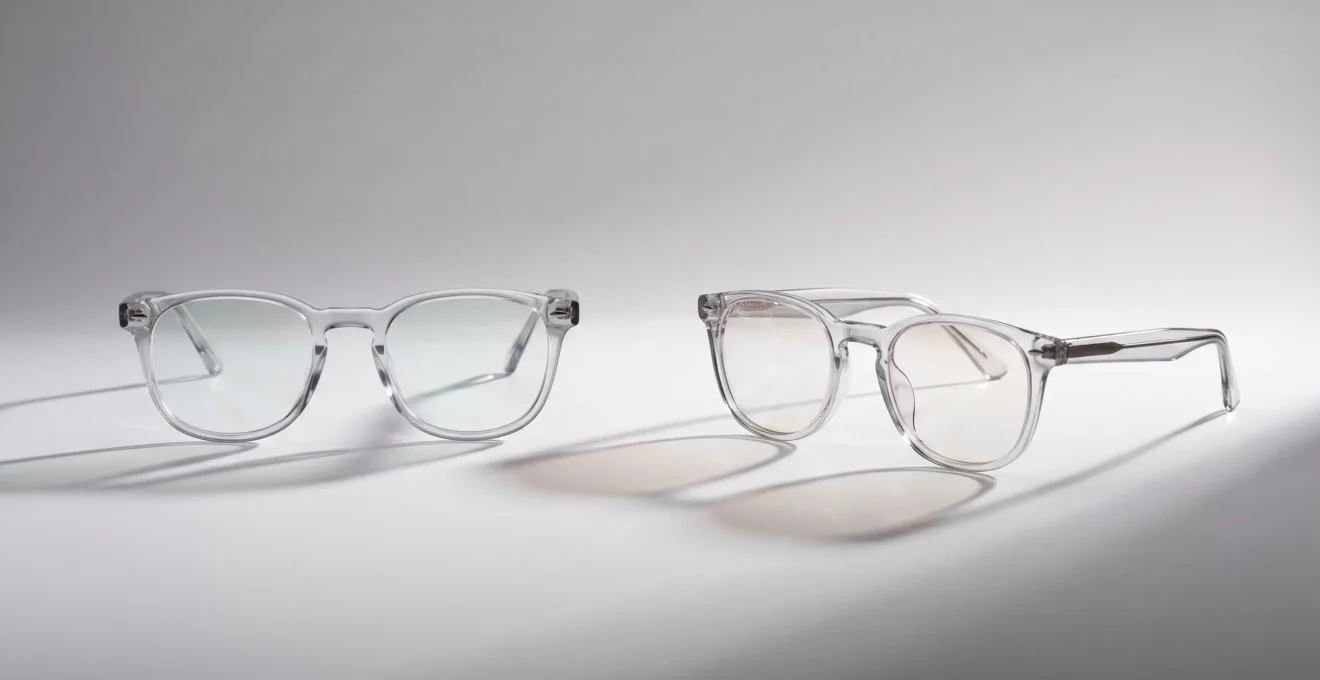
The “free” pair of glasses in a two-for-one deal is a phantom saving, as the true expense is hidden within the inflated cost of lens upgrades and coatings.
- Most high-street deals cover only basic lenses, making expensive add-ons for thinness, anti-glare, and blue light filtering almost mandatory.
- The scientific evidence for pricey blue light filters is weak, and cheaper alternatives often provide better eye strain relief.
Recommendation: Ignore the headline offer. Instead, focus on getting a single, high-quality pair with only the necessary lens features, paid for with a transparently priced frame.
The “two pairs for the price of one” offer is the cornerstone of high-street optical marketing. It promises unbeatable value, a chance to get a spare pair, sunglasses, or a different style for free. But for savvy shoppers trying to get real value, this promise often feels hollow. You walk in for a £99 deal and walk out with a £400 bill, wondering what just happened. The frustration is real, and it stems from a fundamental misunderstanding of how glasses are priced.
Most consumers focus on the frame, but opticians know the real profit is in the lenses. The industry relies on a complex pricing model—a ‘cost architecture’—built on a series of opaque upgrades. You’re sold on a “free” frame, but then steered towards high-index lenses, multi-layer coatings, and filters that quickly inflate the final cost. The deal isn’t a scam, but it is a carefully constructed gimmick designed to upsell you. The advertised price is merely the entry ticket to a much more expensive ride.
But what if the key wasn’t chasing phantom savings, but deconstructing this cost architecture? This guide moves beyond the marketing slogans to give you an insider’s view. We will dissect the value equation of each component, from online measurements and blue light filters to the real cost of high-index lenses and the fine print of insurance plans. By understanding where the true costs lie, you can dismantle the sales pitch and build a pair of glasses that offers genuine value, not just the illusion of a bargain.
To navigate this complex landscape, we will break down the most common questions and cost drivers you’ll encounter. This structured approach will equip you with the knowledge to challenge assumptions and make informed financial decisions about your eyewear.
Summary: Two Pairs for One: How to Navigate Optical Marketing Gimmicks?
- Buying Glasses Online: Can You Trust the Measurements?
- Blue Light Filters: Science or Sales Pitch?
- NHS Vouchers: What Do They Actually Cover for Kids?
- Broken Glasses: Does Home Insurance Cover Accidental Damage?
- UV400 Protection: Why Cheap Sunglasses Can Damage Your Eyes?
- Why High-Index Lenses Cost More Than the Frames?
- Klarna vs Credit Card: Does BNPL Build Your Credit History?
- Health Cash Plans: Getting £100 Back for Your Glasses Every Year?
Buying Glasses Online: Can You Trust the Measurements?
The promise of buying glasses online is seductive: cut out the middleman and save a fortune. While the price difference can be significant, the hidden cost often lies in the lack of professional oversight. The most critical measurement for your glasses, the Pupillary Distance (PD), is notoriously difficult to take accurately yourself with a ruler and a mirror. A small error might seem trivial, but an incorrect PD can force your eyes to strain, leading to headaches, fatigue, and dizziness.
Beyond the PD, the vertical positioning of the lens centre and the wrap-around angle (pantoscopic tilt) are just as important, especially for higher prescriptions or varifocals. These measurements are impossible for an online-only retailer to take. They are part of the skilled fitting process an optician provides. This lack of precision has real-world consequences. In fact, independent testing has repeatedly found that a significant portion of glasses purchased online fail to meet required safety and accuracy standards. A recent UK consumer watchdog test revealed that 1 in 4 pairs bought online did not meet British Standards.
So, can you trust online measurements? For very low, simple prescriptions, the risk is smaller. For anyone with a moderate to high prescription, astigmatism, or a need for varifocals, the answer is a firm no. The “saving” you make on the purchase price can be quickly eroded by the cost of discomfort and the potential need to replace a pair of glasses that you simply cannot wear. The value equation here is poor; you trade professional accuracy for a discount that carries a significant risk of failure.
This doesn’t mean online retailers have no place; they can be a great option for a second pair or for sunglasses where precision is less critical. However, for your primary pair, the in-person fitting is not a luxury—it’s an essential part of the product.
Blue Light Filters: Science or Sales Pitch?
Blue light filtering lenses have become the default upsell in nearly every optical practice. Marketed as a solution for digital eye strain and poor sleep, they come with a premium price tag. But before you add another £30-£60 to your bill, it’s crucial to look at the science, not the sales pitch. The theory is that the high-energy visible (HEV) light from screens disrupts our circadian rhythms and tires our eyes. The solution? A special coating that filters out a portion of this blue light.
This sounds plausible, but the scientific backing is surprisingly weak. The amount of blue light from a screen is a fraction of what you receive from natural daylight. More importantly, the problem of “digital eye strain” is often misattributed. It’s typically caused by reduced blinking, poor posture, and focusing at a fixed, close distance for long periods—not by blue light itself. A comprehensive analysis of multiple studies delivered a damning verdict on the marketing claims. A major 2023 review in the Cochrane Database of Systematic Reviews, which analysed 17 randomised controlled trials, concluded:
Comprehensive analysis of 17 randomized controlled trials found no significant short-term advantages of blue-light filtering lenses for reducing visual fatigue or improving sleep quality.
– Cochrane Database of Systematic Reviews, Blue-light filtering spectacle lenses research review (2023)
This image provides a conceptual look at the digital fatigue that many attribute solely to blue light.
As the visual suggests, the feeling of strain is complex. The coating’s effectiveness is also questionable. Most standard blue light lenses only filter about 10-25% of blue light, which is not a significant reduction. A far more effective and free strategy for reducing eye strain is the 20-20-20 rule: every 20 minutes, look at something 20 feet away for 20 seconds. This simple habit relaxes your eye muscles and does more for your comfort than an expensive, scientifically dubious coating.
The verdict? For most people, blue light filters represent a poor value equation. They are a classic example of a product created to solve a problem that is better addressed by behavioural changes. Save your money and practice better screen habits instead.
NHS Vouchers: What Do They Actually Cover for Kids?
For parents in the UK, the NHS optical voucher scheme seems like a straightforward benefit. If your child is under 16 (or under 19 and in full-time education), they are entitled to a voucher to help cover the cost of glasses. However, many parents are surprised to find that this “free” provision often leaves them with a significant bill. This is a classic example of a coverage gap, where the public perception of a benefit doesn’t match the financial reality.
The value of the voucher is not a flat rate; it depends directly on the strength of your child’s prescription. The system is designed with a series of lettered bands (A-J), with higher bands for more complex or powerful prescriptions. According to official figures, the NHS optical voucher values range from £42.40 to £233.56. The higher end is reserved for exceptionally complex prescriptions, often involving prisms or high-powered lenses. The vast majority of children have simpler prescriptions that fall into the lowest bands.
The reality for most families is that the voucher they receive is worth just £42.40. This amount is intended to cover a pair of basic glasses with standard, uncoated lenses from a limited range of frames. In today’s market, where even children’s frames can be stylish and durable, this amount rarely covers the full cost. If your child wants a more fashionable frame, or if you opt for essential add-ons like anti-scratch coatings or thinner lenses for comfort, the voucher’s value is quickly exhausted. The optician simply deducts the voucher’s value from the total retail price, and you pay the difference. The voucher isn’t a blank cheque; it’s a fixed contribution towards a potentially much larger cost.
This system highlights a core principle of eyewear economics: the base product is often just the starting point. The voucher covers the basics, but the final cost is driven by the desire for durability, style, and features that fall outside its limited scope.
Broken Glasses: Does Home Insurance Cover Accidental Damage?
When an expensive pair of glasses meets an unfortunate end—sat on, knocked off a table, or claimed by a toddler—the first thought for many is their home insurance. If you have ‘Accidental Damage’ cover included in your policy, you might be in luck. This add-on is designed to cover mishaps that aren’t caused by wear and tear or mechanical failure. However, making a claim for your glasses is not always the most financially prudent decision.
The first hurdle is the policy excess. This is the fixed amount you have to pay towards any claim. If your excess is £250 and your glasses cost £300 to replace, you will only receive £50 from the insurer. For glasses costing less than your excess, making a claim is pointless. The second factor is the potential impact on your no-claims bonus, which could increase your premium for years to come. In the UK, accidental damage made up 25% of home insurance claims with an average payout far exceeding the cost of spectacles, which can make insurers wary.
This is where the value equation becomes critical. You must weigh the small, immediate payout against the long-term cost of a higher premium. For this reason, many people consider dedicated glasses insurance or simply “self-insuring” by keeping a backup pair. The following table breaks down the economic trade-offs of each approach.
| Coverage Type | Home Insurance (with Accidental Damage) | Dedicated Optical Insurance | Self-Insurance (Backup Pair) |
|---|---|---|---|
| Annual Cost | Typically £20-£120 extra premium | £15-£40 per year | One-time £15-£100 |
| Excess Payment | Yes (typically £50-£500) | Varies by provider (£0-£50) | None |
| Claims Process | Formal claim, may affect no-claims bonus | Direct replacement at optician | Immediate use |
| Coverage Scope | At home + away (if specified) | Unlimited claims, 1-2 years | Unlimited availability |
| Best For | High-value glasses (£300+) | Frequent damage, children | Moderate-value glasses |
For exceptionally expensive glasses (over £500), claiming on home insurance might make sense. For most, a dedicated policy or a cheap backup pair offers a more cost-effective and hassle-free solution to the inevitable accident.
UV400 Protection: Why Cheap Sunglasses Can Damage Your Eyes?
In the world of optical savings, there is one area where cutting corners is not just a bad value equation—it’s dangerous. That area is ultraviolet (UV) protection in sunglasses. Many assume that the darker the lens, the more protection it offers. This is a critical and harmful misconception. The darkness of a lens (its tint) has no bearing on its ability to block invisible UV radiation.
The key standard to look for is UV400 protection. This label certifies that the lenses block 99% to 100% of UVA and UVB rays, up to a wavelength of 400 nanometres. This protection is achieved through a special, clear coating applied to the lenses or by building it directly into the lens material itself. Crucially, this protective element is independent of the lens colour or darkness.
Herein lies the danger of cheap, uncertified sunglasses. When you wear any dark lens, your pupils naturally dilate to let in more light. If those lenses lack proper UV protection, this biological response becomes a liability. Your dilated pupils create a wider gateway, allowing more damaging UV radiation to enter and reach your retina than if you were wearing no sunglasses at all. It’s a paradoxical situation where a product meant to protect you actually increases your risk.
Chronic exposure to UV radiation is linked to serious eye conditions, including cataracts, macular degeneration, and even cancers of the eye and eyelid. Paying £5 for a pair of fashionable sunglasses on a market stall might feel like a savvy saving, but if they lack the UV400 certification, you are essentially paying to damage your eyes. This is the ultimate phantom saving—a short-term financial gain that creates a long-term health deficit.
Unlike optional coatings or frame materials, UV400 protection is not a feature to be debated. It is the fundamental purpose of sunglasses. A savvy shopper knows this is one part of the cost architecture where paying for certified quality is the only sensible economic choice.
Why High-Index Lenses Cost More Than the Frames?
For those with stronger prescriptions, the biggest shock in the optical cost architecture is often the price of the lenses themselves. It’s not uncommon for a pair of high-index lenses—lenses designed to be thinner and lighter—to cost significantly more than the designer frame they are fitted into. This isn’t arbitrary price gouging; it’s a reflection of complex material science and manufacturing processes.
Standard plastic lenses (CR-39) have a refractive index of around 1.5. High-index lenses, with indices of 1.6, 1.67, or 1.74, are made from more advanced materials. These materials can bend light more efficiently, meaning less material is needed to achieve the same prescriptive power. This results in the desirable thin and lightweight profile that prevents the “coke bottle” effect. However, the raw materials for these lenses are far more expensive, and the manufacturing is more demanding. The process of curing the liquid monomer into a solid lens can take many hours longer for high-index materials, consuming more energy and factory time.
Furthermore, the yield is lower. The precision required to grind and polish a high-index lens is greater, and the material is less forgiving of error. This means more lenses are discarded during quality control, and the cost of that waste is passed on to the consumer. The final price reflects not just the material, but the expertise, time, and technology required to turn it into a perfect, custom-made medical device. A £200 frame is a mass-produced accessory; a £300 pair of high-index lenses is a piece of bespoke optical engineering.
Action Plan: Do You Really Need High-Index Lenses?
- Assess your prescription: Is your total power (Sphere + Cylinder) greater than +/- 3.00? If no, the cosmetic benefit of high-index is minimal.
- Consider the frame choice: A smaller, rounder frame will make any lens appear thinner at the edges. Have you explored smaller frames before upgrading the lens material?
- Request a thickness comparison: Ask your optician to show you a digital simulation or physical sample of your prescription in a standard 1.5 index versus a 1.6 or 1.67 index. Is the visible difference worth the cost?
- Evaluate the weight: For prescriptions below +/- 4.00, the weight difference between 1.5 and 1.6 index is often negligible. Can you feel a real difference?
- Analyse the value equation: Calculate the cost per millimetre of thickness saved. A £100 upgrade for a 2mm reduction might be worthwhile, but a £150 upgrade for a 1mm reduction is poor value.
The key for a savvy shopper is to find the benefit threshold. A 1.67 index lens might be a necessary and valuable investment for someone with a -8.00 prescription, but an unnecessary luxury for someone with a -2.50. It’s about paying for a genuine functional and aesthetic improvement, not just for a higher number on a spec sheet.
Klarna vs Credit Card: Does BNPL Build Your Credit History?
When faced with a surprisingly high bill for a new pair of glasses, the offer to “Buy Now, Pay Later” (BNPL) with a service like Klarna or Clearpay can seem like a welcome relief. It splits the cost into manageable, interest-free instalments, making the purchase feel more affordable. This is often positioned as a modern, flexible alternative to a traditional credit card. However, when it comes to your long-term financial health, the two are not interchangeable.
The most significant difference lies in credit reporting. When you use a traditional credit card responsibly—making payments on time and keeping your balance low—that positive activity is reported to the three main credit reference agencies (Experian, Equifax, and TransUnion). This builds a positive credit history, which can make it easier and cheaper to get a mortgage, car loan, or mobile phone contract in the future. A credit card is a tool for building a credit score.
BNPL services have historically operated outside of this system. While they perform a “soft check” on your file that doesn’t affect your score, your on-time payments were not typically reported. This is changing. Some BNPL providers have started sharing payment data with credit agencies. However, the impact is not the same. Currently, this data often appears on your file but may not be incorporated into your main credit score by lenders. More importantly, missed BNPL payments are increasingly being reported and can negatively impact your score, just like any other defaulted debt. So, you take on the risk of damaging your score without necessarily getting the benefit of building it.
The value equation is clear: a credit card, used correctly and paid off in full each month, is a financial tool that offers consumer protection (Section 75) and builds your credit profile. BNPL is primarily a budgeting tool that delays a payment. It offers convenience but carries the risk of damaging your credit score with little to no upside for building it.
For a one-off, manageable purchase you can afford, BNPL is a convenient option. For building a long-term financial reputation, a credit card remains the superior instrument.
Key Takeaways
- Headline deals like “2-for-1” are marketing tools; the real cost is in the mandatory lens upgrades not covered by the offer.
- Pricey add-ons like blue light filters often lack strong scientific backing and can be replaced with free behavioural changes like the 20-20-20 rule.
- The most important feature on any pair of sunglasses is UV400 certification; cheap, uncertified glasses can be more harmful than wearing none at all.
Health Cash Plans: Getting £100 Back for Your Glasses Every Year?
Beyond traditional insurance, there is another financial tool savvy consumers use to manage their eyewear costs: the health cash plan. Often confused with private medical insurance, a cash plan operates on a much simpler principle. It’s less about insuring against unexpected catastrophe and more about budgeting for predictable, routine healthcare costs, including dental, physiotherapy, and, crucially, optical expenses.
Here’s how it works: you pay a fixed monthly premium, typically from £10 to £30. In return, the plan allows you to claim back a set amount of cash for various treatments each year. For optical benefits, this might mean you can claim back up to, say, £150 towards the cost of new glasses, contact lenses, or eye tests. You pay your optician as normal, then submit the receipt to the cash plan provider, who reimburses you directly up to your annual limit.
The beauty of this system is its predictability. Unlike insurance claims that can be complex and affect future premiums, a cash plan claim is a simple administrative task. There’s no excess to pay, and your premium doesn’t increase because you use the benefits. The value equation is straightforward: if your annual premium is £120 (£10/month) and you know you’ll spend at least £100 on glasses or contact lenses each year, the plan effectively pays for itself. Any other benefits you claim for dental check-ups or other therapies become a net financial gain.
However, there’s a catch: the benefits are “use it or lose it.” If you don’t claim your optical allowance within the policy year, it doesn’t roll over. The model works for people who are proactive about their routine health appointments and eyewear updates. It is a poor choice for those who only visit an optician sporadically. It forces a disciplined approach to health spending, which can be a positive motivator for many.
Ultimately, a health cash plan shifts the financial perspective. Instead of viewing glasses as a large, infrequent expense, it reframes the cost as a manageable, predictable part of your annual budget, empowering you to access the care and products you need without financial hesitation.